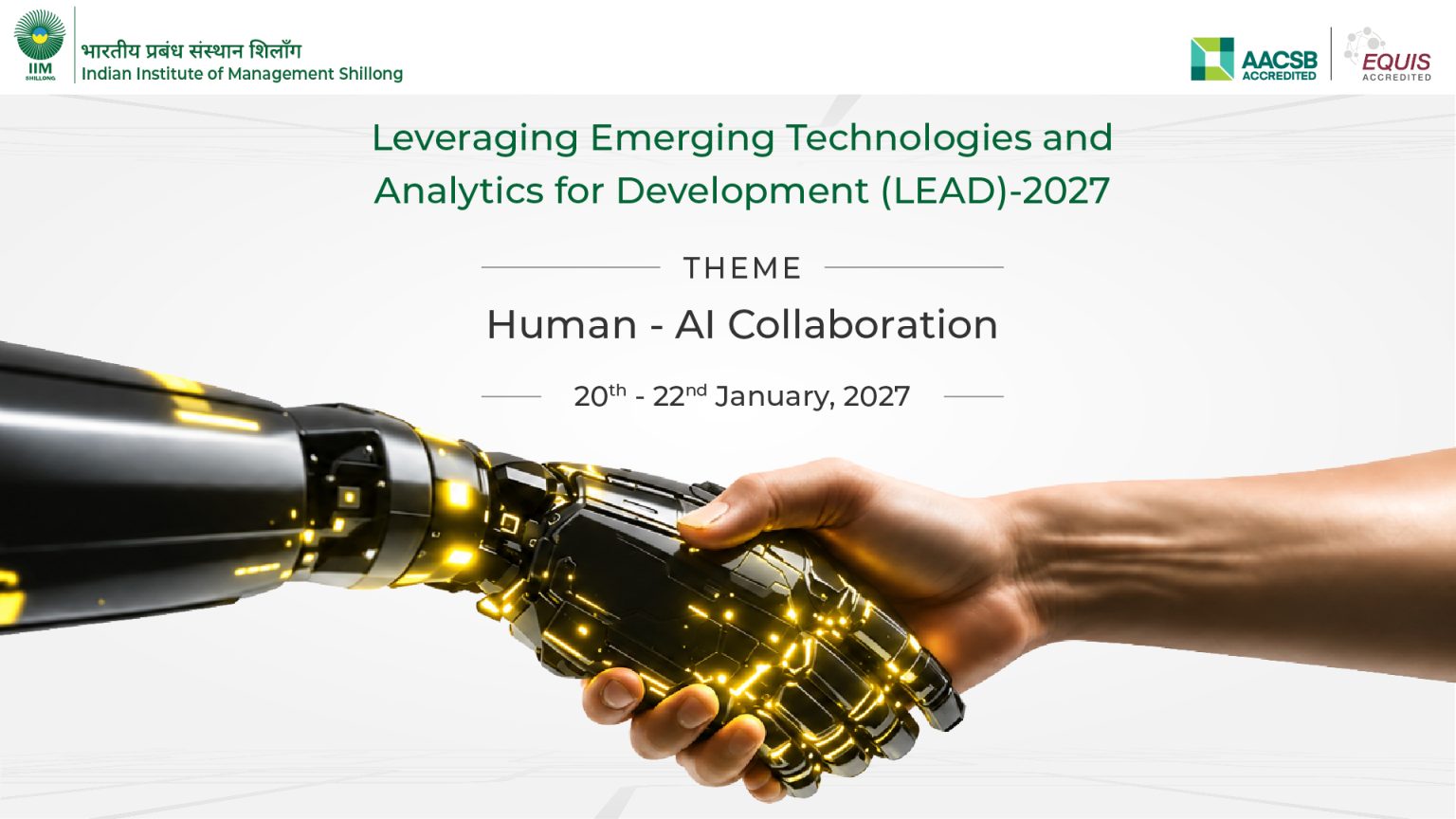
Leveraging Emerging Technologies and Analytics for Development (LEAD) – 2027
Theme: Human-AI Collaboration
(20th – 22nd January, 2027 )
About LEAD-2027
The Leveraging Emerging Technologies and Analytics for Development (LEAD)-2027 is a premier international conference bringing together scholars, industry leaders, policymakers, and innovators to explore the transformative power of technology and analytics. This year’s theme, “Human-AI Collaboration,” highlights the role of emerging technologies, artificial intelligence, data-driven decision-making, and digital transformation in enhancing human capabilities, fostering inclusive growth, and driving sustainable development. As businesses and societies navigate rapid technological changes, this conference aims to spark insightful discussions on harnessing these advancements for economic progress, social empowerment, and ethical innovation.
LEAD-2027 will feature keynote speeches, panel discussions, hands-on workshops, and paper presentations by leading experts from academia and industry. The conference will delve into critical topics such as AI-driven workforce augmentation, the ethical implications of automation, the intersection of human cognition and machine intelligence, and the use of analytics in public policy and business strategy. Special sessions will address the role of digital ecosystems in enhancing education, healthcare, financial inclusion, and governance. The event will provide actionable insights into leveraging technology to maximise human creativity, productivity, and well-being by fostering cross-disciplinary dialogues and real-world case studies.
Participants can engage in networking sessions, collaborative research discussions, and industry-led innovation showcases, ensuring meaningful ideas and best practices exchanges. The scenic setting of IIM Shillong, surrounded by the lush landscapes of Meghalaya, offers an inspiring environment for intellectual engagement and interdisciplinary learning. As a platform for thought leadership, LEAD-2027 is set to shape the future of how emerging technologies and data analytics can empower individuals, businesses, and societies to reach their full potential.
Conference Objectives
- To provide an international platform for scholars, practitioners, policymakers, and industry leaders to exchange ideas and research on emerging technologies, analytics, and human–AI collaboration.
- To explore the role of Human–AI collaboration in driving sustainable, inclusive, and innovation-led development across sectors and geographies.
- To promote interdisciplinary research and partnerships that integrate technological capabilities with human creativity, judgment, and decision-making.
- To encourage discussions on ethical, responsible, and trustworthy AI practices that support societal well-being and long-term development goals.
Brochure
To be updated
Sponsorship Brochure
To be updated
Contribution of LEAD-2027 to Sustainable Development Goals (SDGs):
LEAD-2027 aligns with the United Nations’ Sustainable Development Goals (SDGs) by addressing critical global challenges through technology, data analytics, and innovation. By fostering interdisciplinary discussions, research collaborations, and real-world applications, the conference will contribute significantly to the following SDGs:
SDG 1: No Poverty
LEAD-2027 will explore how financial technology (fintech), AI-driven microfinance, and data-driven policymaking can enhance economic inclusion for marginalized communities. Sessions on poverty alleviation through digital transformation will highlight innovative solutions such as mobile banking for the unbanked, AI-based credit assessment models, and blockchain for transparent social welfare distribution. The conference will facilitate knowledge sharing on how analytics can optimize resource allocation and social impact measurement for poverty reduction initiatives.
SDG 4: Quality Education
By emphasizing AI-driven personalized learning, digital classrooms, and edtech innovations, the conference will showcase how technology can improve educational accessibility and learning outcomes. Key discussions will focus on using adaptive learning platforms, virtual reality (VR) in education, and AI-powered skill development programs to bridge the digital divide. Experts will also discuss strategies for upskilling and reskilling the workforce to prepare them for the future of work in an AI-driven world.
SDG 9: Industry, Innovation, and Infrastructure
The conference will drive discussions on smart infrastructure, AI-powered industrial automation, and digital transformation strategies that foster sustainable economic growth. Case studies on Industry 4.0, IoT-enabled manufacturing, and blockchain applications in supply chain management will highlight how businesses can adopt emerging technologies to enhance efficiency and resilience. Startups and researchers will also be able to showcase innovative solutions that can drive sustainable industrialization.
SDG 16: Peace, Justice, and Strong Institutions
By addressing the role of technology in governance, cybersecurity, and ethical AI, LEAD-2027 will contribute to building transparent, inclusive, and accountable institutions. Sessions on data-driven policymaking, AI for legal decision-making, and blockchain for anti-corruption initiatives will explore how technology can promote justice and trust in public administration. Discussions on AI ethics, misinformation detection, and regulatory frameworks will also emphasize the need for responsible and fair AI governance.
SDG 17: Partnerships for the Goals
LEAD-2027 will be a global platform for collaboration among academia, industry, government, and international organizations. The conference will enable the co-creation of technology-driven solutions for sustainable development by fostering cross-sector dialogues, research partnerships, and industry-academia collaborations. Panel discussions on public-private partnerships (PPPs), AI ethics coalitions, and data-sharing initiatives will highlight how collective efforts can drive meaningful progress toward the SDGs.
Call for Papers
Conference Tracks
The conference provides a global platform for engaging in dialogues and deliberations. Papers are welcomed for the following topics (not limited to):
Track 1: Information Systems: Theory and Practice
- Digital Transformation and Society: Socio-technical Systems, Digital Inclusion and Accessibility, Digital Divide
- Social Media and Networks: Online Communities, Social Network Analysis, Influence and Virality
- Information Behaviour and Use: Information Seeking Behaviour, Information Use in Decision Making, Information Literacy
- Digital Ethics and Policy: Ethical Use of Information Technology, Privacy Concerns, Regulation and Compliance
- ICT for Development: Technology Adaptation in Developing Countries, ICT for International Competitiveness*, ICT for Economic Development, ICT for Social Development
- Online Collaboration and Communication: Virtual Teams and New Product Development*, Computer-Mediated Communication, Online Community Building
- Cultural and Global Perspectives: Cross-Cultural Studies, Globalisation and Technology, Cultural Influences on Technology Use
- Gender and Diversity in Technology: Gender Digital Divide, Diversity in IT Workforce, Gender Bias in Technology Design
- Digital Well-being: Technostress, Digital Detox, Psychological Effects of Digital Technologies
- Education and Learning Technologies: Technology Integration in Education, Online Learning Environments, Educational Technology Adoption and Impact
- Information Systems Strategy and Competitiveness.
Track 2: Analytics: Application for Business and Human Development
- Healthcare Analytics: Public Health and Epidemiology, Predictive Public Healthcare
- Education and Learning Analytics: Personalised Education, Educational Equity
- Climate Change Analytics and Resource Management
- Poverty Alleviation and Social Welfare: Targeted Assistance Programs, Economic Inclusion
- Justice and Equity: Criminal Justice Reform, Human Rights and Fair Labour
- Urban Planning and Development: Smart Cities, Infrastructure and Mobility
- Disaster Response and Management: Early Warning Systems, Emergency Resource Allocation
- Public Safety and Security: Crime Prevention, Cybersecurity
- Community Empowerment: Civic Engagement and Participation, Social Media for Good
- Global Development and Aid: Development Aid Allocation, Monitoring and Evaluation and Strategies
Track 3: Information Systems and Analytics for Marketing
- Digital and social media marketing
- Big data and marketing analytics
- AI and marketing
- AR/VR/Metaverse marketing
- Value cocreation using internet and mobile technology
- Content marketing
- Blockchain and marketing
- Ethical issues in tech-enabled marketing
- Chatbots/virtual assts and customer engagement
- Role of technology in sustainable market transformation
- Technology and customer wellbeing
- IT Strategies for Marketing
Track 4: Information Systems and Analytics for Human Resources & Organisational Behaviour
- Improving employee experience with technology
- Leveraging technology to build humane organisations.
- AI and the evolution of jobs.
- Improving contingent work through technology
- HR bias and technology
- Laws and compliance issues in tech-enabled HRM
- HR Excellence: IT Strategies for HRM, Capability maturity models.
Track 5: Information Systems and Analytics for Operations and Quantitative Techniques
- Smart Manufacturing and Industry 4.0
- Humanitarian Logistics and Disaster Response
- Smart Cities and Urban Operations Management
- Edge Computing and IoT in Operations
- Robotic Process Automation (RPA) in Operations
- Predictive Maintenance and Asset Management
- Ethical and Social Implications of IT in Operations
- Agile Operations and Adaptive Supply Chains
- Supply Chain Resilience and Risk Management
- Sustainable Supply Chains
- Supply Chain Visibility and Collaboration
- Cybersecurity and Data Privacy in Supply Chains
- Supply Chain Digital Twinning
- IT Strategies for supply chain operations
Track 6: Information Systems and Analytics for Finance and Economics
- Financial Inclusion and Accessibility: Digital Wallets and Mobile Payments, Peer-to-Peer Lending
- Data-Driven Decision-Making: Predictive Analytics, Machine Learning for Investments
- Financial Education and Literacy: Online Education Platforms, AI-Powered Financial Coaching
- Transparency and Accountability: Blockchain, Smart Contracts, Fintech
- Sustainable and Ethical Finance: Impact Investing Platforms, ESG Analytics
- Robotic Process Automation (RPA), Digital Currencies and Cryptocurrencies
- IT Strategy for Finance and Economics
Track 7: Management of Technology and Competitiveness
- Management of Technology and Innovation (MoT)
- Technology Transfer and Absorption
- MoT for Export Competitiveness
- Digital Platforms and Transformation
- Product and Service Innovation
- International Competitiveness and Business (IB), Outbound Foreign Direct Investment (OFDI)v
Type of Submission
LEAD-2027 invites academicians, research scholars, and corporate/industry executives to submit Full paper (Research Paper (Qualitative / Quantitative/ Mixed Methods), Literature Review, Case Study, Conceptual paper, Tools demo paper) or Abstract fitting to the tracks mentioned above. Authors wishing to submit multiple papers will have to do so separately.
Author Guidelines
- Submit the papers as per the templates attached here. The author guidelines for preparation of manuscripts are given in respective templates.
- LEAD-2027 Conference Abstract Template Click Here
- LEAD-2027 Conference Full Paper Template Click Here
- Registration details can be communicated to accepted authors by mail. (see registration fees).
- Atleast one author of accepted paper should present work.
- Plagiarism should be below 10%.
- Follow COPE Position of using Generative AI given at the k: https://publicationethics.org/guidance/cope-position/authorship-and-ai-tools
Submission Guidelines
Authors are advised to follow the rules related to formatting, abstract length, number of words for each section, font size, anonymity and references given respective template.
Important Dates
| Events | Important Dates |
|---|---|
| Last Date for Full Paper/ Abstract /Extended Abstract Submission | 10th of November, 2026 (Tuesday) |
| Final Decision on Full Paper Submission | On or before 15th November, 2026 (Sunday) |
| Registration Date | 16th November 2026 Onwards |
Registration Fees - To be updated
Paper Development Workshop (PDW)
For LEAD-2027 Conference Aspirants, there will be a PDW proposed to be conducted on 8th August 2026 (Saturday) virtually. For PDW Working Paper (either .doc format or .pdf format) can be mailed (with subject: PDW Submission) in free-format to leadconf@iimshillong.ac.in on or before – 31st of July 2026 (Friday). There are no registration fees for this PDW.
Review Process
Submitted full papers/abstracts will undergo a double-blind peer review process (no author name is to be included in the manuscript) based on relevance, originality, significance, and clarity. Authors will be notified of revision/ acceptance/ rejection by the specified deadline.
Format
The conference will feature keynote presentations, paper presentations, industry and academic panel discussions, pre-conference workshops, and tools/application demonstrations.
Who can Participate
Researchers, academics, industry professionals, policymakers, students, and other stakeholders interested in the application of emerging technologies for unlocking human potential.
Conference Committees
Advisory Committee
- Prof Arpan, IIT Delhi, India
- Prof Baidyanath Biswas, Ireland
- Prof. Indranil Bose, Neoma Business School, France
- Dr. Jang Bahadur Singh, IIM Trichy
- Prof. Manojit, IIM Raipur, India
- Prof. Rameshwar Dubey, France
- Prof Somnath Mukhopadhyay, USA
- Prof Sudhir Rana, UAE
- Prof. Sujeet K. Sharma, IIM Nagpur
- Dr. Viswanath Venkatesh, USA
- Prof. Yogesh K. Dwivedi, Saudi Arab
Organizing Committee
Conference Patron - Prof. Naliniprava Tripathy, Director-in-Charge, Indian Institute of Management, Shillong
Conference Chair - Prof. Parijat Upadhyay
Committee Members -
- Prof. Pradeep Kumar Dadabada
- Prof. Basav Roychoudhury
Research Scholars -
- Ms. Sagarika Paul
- Ms. Shompy Das
Knowledge Partners
The institute expressed interest in being part of LEAD-20275 is:
Trinity College Dublin, (https://www.tcd.ie/business/) abbreviated as Trinity or TCD, officially titled The College of the Holy and Undivided Trinity of Queen Elizabeth near Dublin, is the sole constituent college of the University of Dublin, Ireland.
Publication partners
LEAD-2027 Conference Proceedings: To be Updated
Published LEAD-2024 Conference Proceedings:
- Volume 1: https://link.springer.com/book/10.1007/978-981-96-2548-2
- Volume 2: https://link.springer.com/book/10.1007/978-981-96-8582-0